Knowing the difference between hands-only CPR and traditional CPR training seems like a minute detail in the grand scheme of saving someone’s life, but if you plan on getting certified, it’s an important distinction. Today, we’re going to explain the difference between hands-only CPR and traditional CPR training, explain how they work and when to use each method, and who to use it on for the most effective results.
What’s the Difference Between Hands-Only CPR and Traditional CPR?
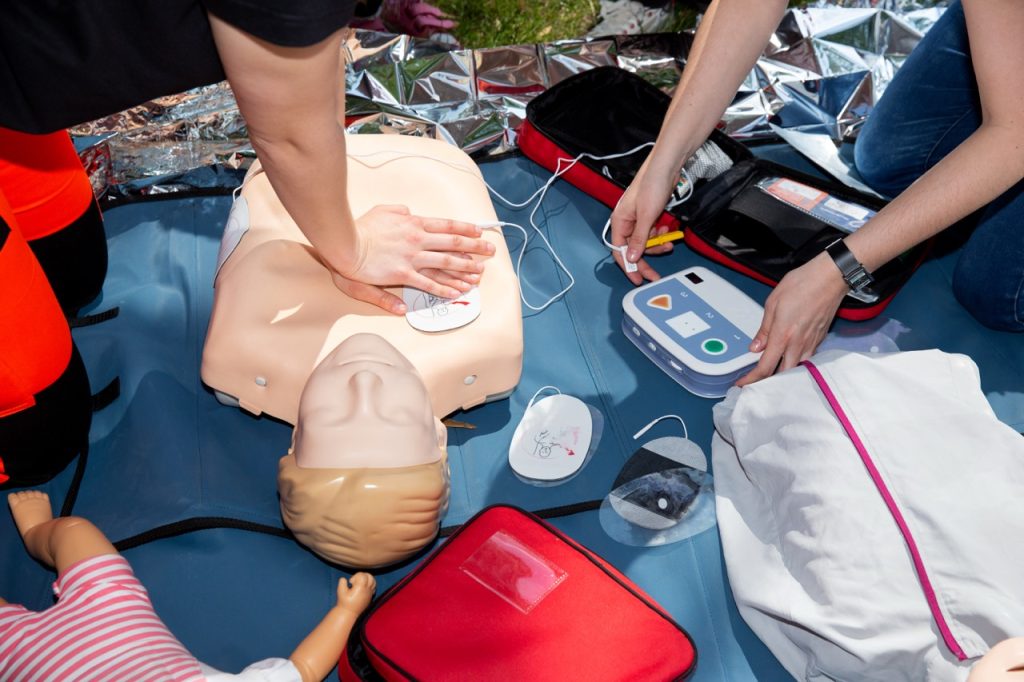
While traditional CPR involves both assisted breath work and chest compressions when someone goes into cardiac arrest, hands-only CPR is only chest compressions. In an emergency, hands-only CPR is just as effective as traditional CPR when started immediately. In fact, the National Library of Medicine concludes that compression-only CPR is better than standard CPR when cardiac arrest occurs outside of a hospital setting. The reason for it is simple: any CPR is better than no CPR.
Related Content: Why Every Caregiver Should Be CPR Certified
Why Compression-Only CPR is Better in Some Situations
Most bystanders are hesitant to use mouth-to-mouth resuscitation on a stranger. However, people are way more likely to utilize compression-only CPR on someone they don’t know. In a medical emergency when someone goes into cardiac arrest, any CPR counts.
While traditional CPR with mouth-to-mouth is most effective in infants and children or when someone is suffocating or drowning, hands-only CPR is a valuable alternative to no response. When someone’s heart stops beating, they have mere minutes until brain damage becomes irreversible—unless they get oxygen flowing again in their body. That’s where CPR—any CPR—comes in handy.
For the first few minutes, there’s already some oxygen left in the body, so compression-only CPR works fine in most teens and adults. Meanwhile, in children, infants, and elderly individuals, mouth-to-mouth helps give them oxygen they might not have. Traditional CPR also works better in emergencies that involve suffocation or drowning, due to the lack of oxygen from the start.
Overall, any CPR is better than no CPR in an emergency that involves cardiac arrest.
Related Content: Practical Ways to Practice CPR Skills at Home
Comparing Hands-Only CPR vs. Traditional CPR
The major difference between hands-only CPR and traditional CPR is whether assisted breathing is included. However, there’s a time and a place for when to use the method and who to use it on.
Hands-Only CPR vs. Traditional CPR |
||
|
Hands-Only |
Traditional |
|
|
Technique |
Basic life-saving method and starting point in learning for general public |
More advanced; taught through in-person and online classes |
|
Effectiveness |
Just as effective as traditional CPR in the first few minutes |
More effective in adding more oxygen and circulating it |
|
How it works |
Chest compressions push oxygen throughout the body to keep vital organs alive until help comes |
Combines chest compressions with breaths to provide additional oxygen and push it throughout the body |
|
When to use it |
When someone is in cardiac arrest |
When someone is in cardiac arrest; better choice for children, suffocation, or drowning |
|
Who it can be used on |
Adults and teenagers |
Anyone: infants, children, teens, adults, elderly, etc. |
|
What to do |
Call 911; push hard and fast in the center of the chest |
Learn CPR with a local class or online training |
How to Perform Hands-Only CPR
In hands-only CPR, the American Heart Association specifies that there are only two steps to save a life when someone goes into cardiac arrest:
- Call 911
- Push hard and fast
When you first notice that someone isn’t breathing or their heart stops, the very first thing you should do is call 911. This step is crucial as the person in cardiac arrest will always need further medical treatment, and you can only give CPR for so long before exhausting yourself.
Next, you’ll want to use two hands (one placed over the other) to give firm, deep compressions (two inches in) on the center of their chest at a rate of 100 to 120 per minute. Keep up with this until help arrives or as long as physically possible.
How to Perform Traditional CPR
Get Certified for Traditional CPR
If you’re ready to learn traditional CPR to save someone’s life in an emergency, HeartCert CPR has everything you need to get started. We offer basic and advanced classes throughout the Midwest to prepare you for emergencies. Whether you’re continuing education in a clinical setting or if you simply want to learn to save a life, our classes offer in-person, online, and hybrid options to help you get started.
HeartCert is your trusted training partner for CPR, ACLS, PALS, EMR, First Aid, CNA, TMA, IV, EKG and more, throughout the United States.
Courses include CPR/AED/First Aid, Basic Life Support (BLS), Advanced Cardiac Life Support (ACLS), Pediatric Advanced Life Support (PALS), Certified Nursing Assistant training, IV training, EKG training, babysitter basics and more. Courses and certifications from both the American Heart Association and American Red Cross are available. We offer virtual courses and certifications, in all 50 states as well as in-person classes at our headquarters, HeartCert CPR Eagan and major cities in Iowa, Illinois, Michigan, Minnesota, Missouri, Mississippi, Nebraska, Pennsylvania, Texas and Wisconsin.